

This course is part of the international master's degree program Climate, Earth, Water, Sustainability (CLEWS). The module provides an understanding of environmental processes and driving forces of the climate system through earth history and deals with the following aspects: geological approaches, climate archives, palaeoecological approaches, proxy records, modelling approaches, icehouse stages and greenhouse stages in earth history, climate variability at long to short time scales, abrupt climate changes, role of the global carbon cycle through time, biospheric-geospheric interactions. The module comprises a lecture series, a seminar with poster presentations by the students, and geological field exercises.
- Kursleiter*in: Prof. Bernhard Diekmann
- Kursleiter*in: Prof. Dr. Georg Feulner
Das ist die Moodle-Seite des Kurses GEW-B-P03 - Einführung in die Geowissenschaften III - Sedimentäre Systeme im Wintersemester 22/23
- Kursleiter*in: Sven Maerz
- Kursleiter*in: Timothy Oluwatobi Tella
- Kursleiter*in: Ahmed Yousef Tawfik Mohamed Yousef
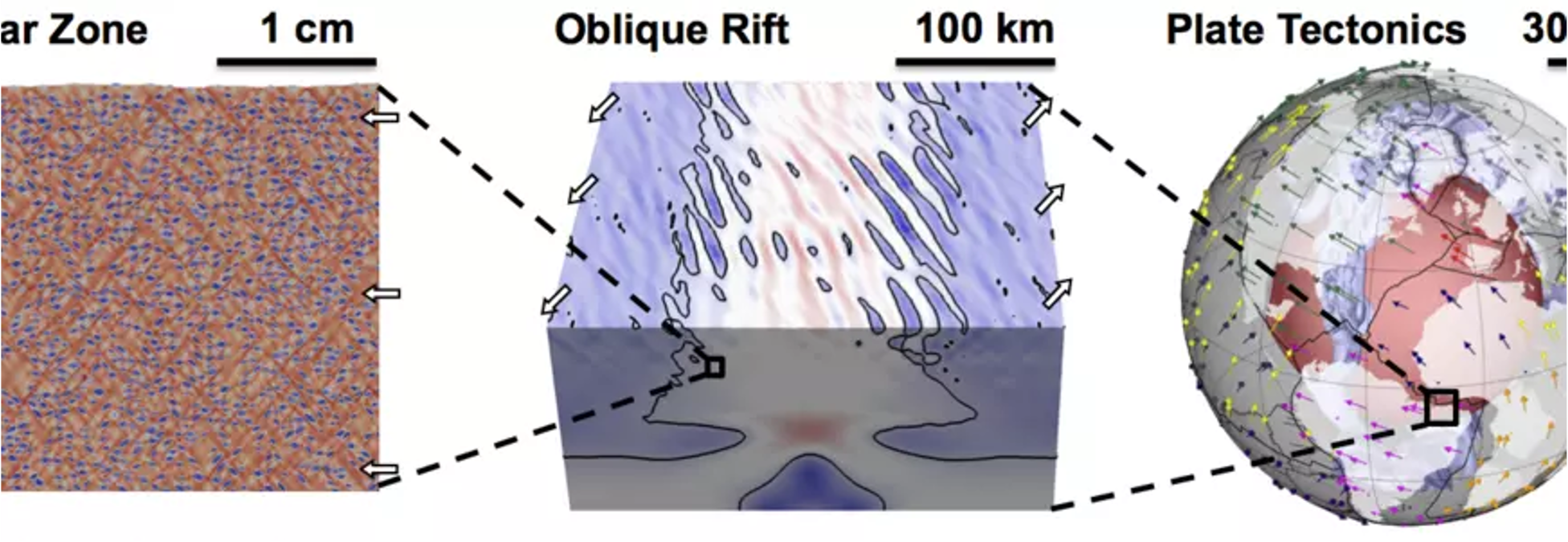
This module aims to familiarise students with current ideas about the structure and mechanical behaviour of the lithosphere, in terms of its thermal structure and rheology. The forces driving plate tectonics, the rheology of the lithosphere, the dynamics of orogenic processes, numerical modelling of deformation of the lithosphere, as well as the coupling between mantle dynamics and surface processes are covered.
Through following this course, students:
- gain an understanding of the structure and dynamics of the lithosphere and the forces driving its deformation
- gain familiarity with modern quantitative methods for observing and modelling the deformation of the lithosphere and its driving forces
- learn to analyse modern research questions in tectonics and geodynamics by studying the literature on a chosen topic
- Kursleiter*in: Sascha Brune
- Kursleiter*in: Prof. Dr. Pieter van der Beek
- Kursleiter*in: Prof. Dr. Eva Eibl
- Kursleiter*in: Tanja Klaka-Tauscher
- Kursleiter*in: Prof. Dr. Frank Krüger
- Kursleiter*in: Dr. phil. Melanie Sieber
- Kursleiter*in: Prof. Dr. Manfred Strecker
- Kursleiter*in: Dr. Martin Timmerman
- Kursleiter*in: Prof. Dr. Pieter van der Beek
- Kursleiter*in: Isabel Wapenhans
- Kursleiter*in: Prof. Dr. Max Wilke
Das Modul vermittelt grundlegende Kenntnisse zu Wärmetransportvorgängen
und die daraus resultierende Wärme- und Temperaturverteilung der
Erdkruste. Neben theoretischen und physikalischen Grundlagen zu
thermischen Gesteinsparametern und thermischen Feldern werden gängige
Verfahren zur Bestimmung der thermischen Eigenschaften vorgestellt;
dabei wird auf die Gewinnung und Bearbeitung der (Mess-) Daten und die
Interpretation der Resultate eingegangen.
- Kursleiter*in: Dr. Sven Fuchs
- Kursleiter*in: Tanja Klaka-Tauscher
- Kursleiter*in: Ines Münch
- Kursleiter*in: Dr. Masafumi Sudo
Introduces the basic concepts of nonlinear dynamics and chaos and how they can be applied for the study of complex systems, spatiotemporal data, and nonlinear interrelationships in geosciences. Methods based on information theory, recurrences properties, and complex networks are taught and their potentials are demonstrated. The fundamentals of statistical tests are introduced and how to construct appropriate statistical tests for specific applications are discussed.
- Basic terminology, dynamical systems, and simple prototypical models
- Dimensions, fractals
- Concept of symbolic dynamics
- Concept of phase space, phase space reconstruction, Lyapunov exponent and correlation sum
- Concept of recurrence in phase space, recurrence plots, recurrence quantification analysis
- Detection of regime transitions, statistical tests
- Concept of synchronization, coupling analysis
- Spatial and spatio-temporal data analysis using recurrence features
- Complex networks, network models, measures, network representations
- Functional networks, reconstruction of networks, climate networks
- Complex networks based time series analysis
- Kursleiter*in: Tobias Braun
- Kursleiter*in: Prof. Norbert Marwan
- Kursleiter*in: Vanessa Skiba
- Kursleiter*in: Sara Maria Vallejo Bernal
- Kursleiter*in: Prof. Dr. Christian Hallmann