

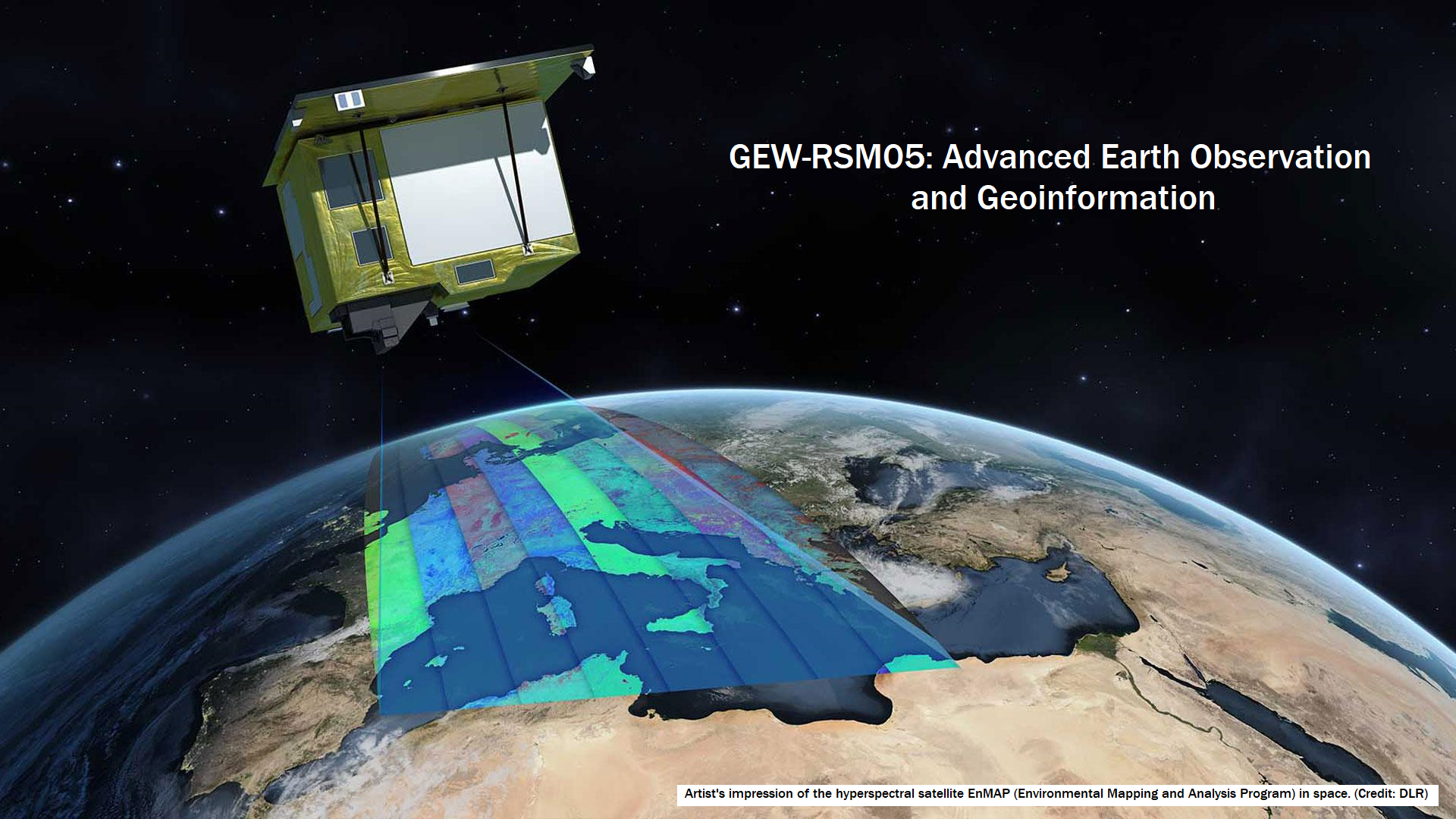
The Advanced Earth Observation module is aimed at students from relevant MSc programs (CLEWS, Geo-Ecology, RSIV) who are interested in deepening their knowledge and experience in the field. The course is designed to build upon the basic remote sensing modules (such as “Angewandte Fernerkundung in der Geoökologie” or “Remote Sensing of the Environment”) and requires students to enter with a basic knowledge of remote sensing principles, methods, and applications. We will use R for lab exercises and expect knowledge in a programming language (i.e., R).
The module provides students the opportunity to acquire further knowledge in the field of Earth Observation on advanced topics with a focus on optical remote sensing, such as more physics on remote sensing, radiative transfer models for biophysical parameter retrieval, LiDAR for deriving vegetation structure, time-series analysis and deep learning methods in land remote sensing, and innovative approaches for in-situ calibration and validation. Advanced knowledge will be provided through lectures by leading remote sensing experts and hands-on experience will be gained through practicals. The teaching and topics of the course are aligned with some of the ongoing research at the German Research Centre for Geosciences (GFZ) in Potsdam and will also link with the recent EO-College online courses MOOC4LAND and HYPERedu. Next to lectures and practicals, part of the course focuses on performing a synthesis on recent Earth Observation papers that will be presented and discussed with the group.
This course is available for multiple Master programs as Master in Science - Geoökologie (GEE-M-V15), Master in Science- Remote Sensing, geoinformation and Visualization (GEW-RSM01) and Master in Science - Computational Science (GEW-RSM01).
- Kursleiter*in: Prof. Dr. Martin Herold